


Where the Soul Grows: What Grief Asks of Us


“Embrace your grief, for there your soul will grow.” Often attributed to Carl Jung
There is something about this line that has stayed with me.
Maybe because it runs counter to so much of what we are taught about grief. We tend to speak about grief as something we need to get through. We look for signs that we are doing better. We measure progress by how often we cry, whether we can talk about what happened without falling apart, whether we are sleeping again, working again, laughing again.
And, of course, those things matter.
But grief is not simply a painful period we endure until we can return to who we were before. Sometimes, there is no returning.
We grieve more than death
When we hear the word grief, most of us think immediately about death. But grief belongs to loss, and loss takes many forms.
We can grieve a relationship that ended, even when ending it was the right decision. We can grieve a friendship that slowly disappeared without ever officially ending. We can grieve illness and the body we had before it. We can grieve aging, our changing appearance, our energy, our independence, or the realization that certain chapters of our lives are behind us. Parents can grieve when their children leave home, while simultaneously feeling enormously proud of the adults they have raised. We can grieve retirement. A new job. Leaving a job. Moving from a house we loved. Selling the family home. Leaving a city. Becoming a caregiver. No longer being a caregiver. We can grieve the family we imagined having. The career we thought we would build. A pregnancy that didn't happen. A relationship with a parent that we finally realize may never become what we needed it to be.
And sometimes grief arrives in much smaller packages.
A favourite restaurant closes. A tradition ends. Someone else buys the house where you grew up. Your child no longer needs you to tuck them into bed. A beloved television series ends, and you find yourself surprisingly sad to say goodbye to people who, technically, never existed.
We form attachments to people, places, routines, identities, hopes, and experiences. When something has mattered to us, its ending can matter too. Not every loss devastates us. But many leave a mark.
And sometimes we don't recognize what we're feeling as grief because nobody died.
Grief and change are close relatives
Some of life's happiest transitions contain grief.
You can love your new home and miss your old one. You can be excited about a new job and mourn the colleagues, competence, and identity you left behind. You can watch your child head off to university with tremendous pride and then walk into their empty bedroom and cry. You can celebrate a milestone birthday and feel startled by the number attached to it. You can know that a relationship needed to end and still miss the person.
Two things can be true.
This is something grief asks us to become better at holding.
We often create unnecessary suffering when we decide that one feeling invalidates another. If I'm happy about this change, why am I sad? If leaving was my choice, why do I miss it? If my child is thriving, why does this hurt? If I'm grateful to be getting older, why am I struggling with aging?
Because something changed.
Because something mattered.
Because you are human.
Grief changes the landscape
When we experience a significant loss, we don't only lose the obvious thing. Loss can change routines, roles, traditions, plans, assumptions, relationships, and our understanding of ourselves.
After the death of someone we love, we may also lose the person who remembered a particular version of us. The person we called first. The person who knew the history behind the story without needing the backstory.
Other losses can unsettle identity in similar ways.
Who am I when my children don't need me in the same way?
Who am I when my body cannot do what it once did?
Who am I outside this marriage, career, home, role, or stage of life?
That is one of the reasons grief can feel so disorienting. The world may continue to look remarkably normal while, internally, the landscape has changed. There can also be an expectation that, with enough time, we should begin putting that landscape back the way it was.
But what if that isn't the work?
What if some of the work of grief is learning the new terrain?
What does it mean to embrace grief?
I don't think embracing grief means liking it. It certainly doesn't mean believing that loss happened for a reason, searching for a lesson before we're ready, or resigning ourselves to feeling terrible. To me, embracing grief means allowing it to have a place in our lives and becoming curious about what is happening within us rather than immediately trying to make it stop.
Grief can contain sadness, but it can also hold anger, guilt, relief, longing, resentment, gratitude, fear, love, and even moments of joy. Sometimes several of those feelings exist at once. That complexity can be uncomfortable, particularly when we believe there is a “right” way to grieve. But our emotional responses to loss are rarely that orderly.
From a Jungian perspective, experiences that unsettle us can bring us into contact with parts of ourselves that everyday life allows us to avoid. Loss can expose questions we had successfully kept at a distance:
Who am I now?
What matters to me?
What have I been postponing?
What do I want to carry forward, and what needs to be left behind?
After the death of someone we love, there may also be the deeply human question of how we continue loving someone who is no longer physically here.
There may not be immediate answers to any of these questions. In fact, trying to answer them too quickly can become another way of trying to tidy up an experience that isn't particularly tidy. Sometimes the questions themselves become part of grieving, and we gradually discover their answers as we live into whatever comes next.
Growing around grief
I am wary of language that makes grief sound like a self-improvement project. There is nothing inspirational about losing someone you love when you are in the middle of missing them, and not every difficult transition needs to become a lesson in personal growth. Growth does not make a loss worthwhile, nor does finding something valuable on the other side mean we needed the loss to happen.
But human beings do have a remarkable capacity to change around what has happened to us. Over time, grief can deepen our understanding of ourselves, alter our relationships, and clarify what we value. It can make us more aware of time, love, connection, and the lives we are actually living. It may also reveal parts of ourselves that were previously overshadowed by a role, relationship, expectation, or version of life that no longer exists.
The person we become after a significant loss is not necessarily a “healed” version of the person who existed before it. She may be someone changed by what she has loved, lost, survived, discovered, and had to reconsider. She carries what has been lost alongside what remains, while slowly making room for what has yet to emerge. Perhaps this is closer to what it means for the soul to grow.
Grief was never meant to be entirely solitary
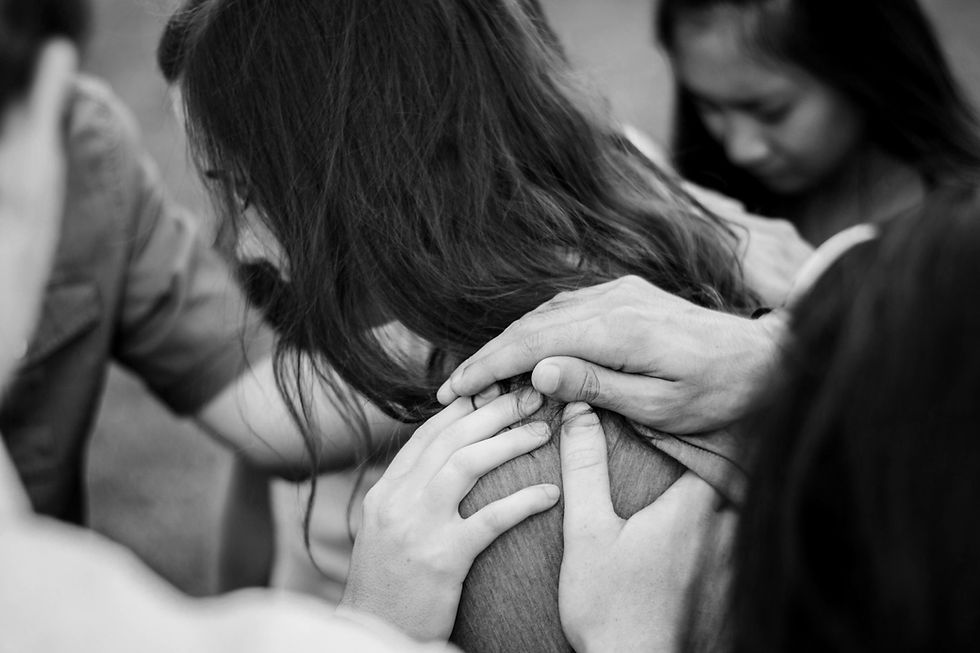
One of the hardest things about grief is how lonely it can become, particularly when the loss isn't one other people readily recognize. After a death, people may eventually stop asking how we are. With other kinds of grief, they may never ask at all.
There is no sympathy card for menopause and usually no casserole when your youngest child moves out. There is no bereavement leave for the end of a friendship, a difficult diagnosis, a divorce, retirement, infertility, a major change in our bodies, or the realization that the life we expected is not the life we are going to have. When the world doesn't recognize something as a loss, it becomes remarkably easy to question whether we are entitled to grieve it ourselves.
We may tell ourselves that other people have it worse, that we chose this change, that we should be grateful, or that whatever is happening is supposed to be a good thing. We can spend a surprising amount of energy arguing with our own feelings. But grief doesn't require us to prove that something mattered enough to mourn it. Sometimes acknowledging that we have lost something, without ranking or defending the loss, is an important part of understanding what we need.
There is also something powerful about grieving in relationship with other people.
Someone listens to the story again. Someone recognizes part of themselves in what we are describing. Someone says, “Me too,” and an experience that felt strangely isolating becomes a little more human. We might cry and then find ourselves laughing five minutes later, without either moment cancelling out the other.
We begin to see that grief and life can occupy the same room.
Rooted & Rising
And so continue to explore, where the soul grows and what grief asks of us.
This October, my sister, Kelly, and I are bringing a small group of women together in Halifax for Rooted & Rising: Grief & Renewal, a three-session therapist-led circle through Apple Tree Therapeutic Counselling. We created Rooted & Rising for women experiencing grief in its many forms. Some may be grieving someone who died. Others may be living through an ending, a transition, a change in identity, or a life that looks different from the one they expected.
There is no need to decide whether your grief is “big enough” to belong there. Rooted & Rising isn't about moving on, finding a silver lining, or arriving with your grief neatly organized. It is an opportunity to spend three Saturday mornings exploring grief in the company of other women, through therapeutic conversation, reflection, and practices designed to help us connect with ourselves, what we have lost, and what may be beginning to emerge.
Perhaps the invitation contained in that line attributed to Jung is not to conquer grief at all, but to make room for it. To understand what we are mourning, honour what mattered, and become curious about who we are becoming as we learn to carry both what was and what comes next.
Perhaps that is where something begins to rise.
October 17, 24, and 31, 2026
Saturdays, 10 a.m. to 12 p.m.
Halifax, Nova Scotia
Three therapist-led sessions for women
Presented by Apple Tree Therapeutic Counselling


Comments